
Up From Liberalism
A Vintage Viewpoint

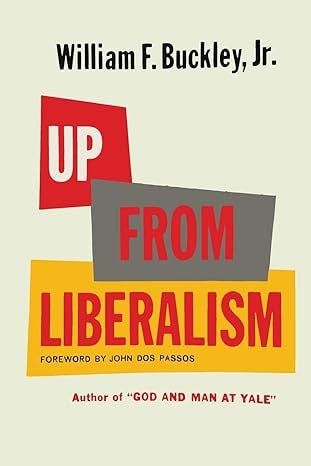
A friend who knew I was researching and reading books on Communism lent me Up From Liberalism by William F. Buckley, Jr. Buckley is a controversial figure, even among conservatives, and his book contains controversial vewpoints, too. First published in 1959, aspects of it are dated, but it’s interesting to read about issues that are still in the forefront of politics today from a perspective that predates the Civil Rights Act and major U.S. involvement in the Vietnam War. The book was written only a few years after Senator Joe McCarthy had dominated headlines.
Buckley maintains that Liberalism offers a Millennium achieved by politics and policies. The Liberal’s mindset is that as soon as a society of tolerance and welfare is established, we can live in Utopia. Logic and reason form no part of the Liberal’s thought process (Buckley distinguishes the modern “Liberal” from the classic definition of “liberal.”) He notes, and provides specific examples from the time, of double standards in press coverage and justice - just as we see today. He harangues Democrats (including Eleanor Roosevelt) and less-than-Conservative Republicans (notably, Eisenhower) for their lack of logic and their obfuscation of meaning in tossed word salads (he does not call them that). Conservatism, he maintains, is a harder “sell,” because it offers no Utopia, and it’s promises are less concrete (freedom, not handouts).
The most interesting thing to me about the book was observing (yet again) how little has changed in politics, even though much has changed in time. As wise, old Solomon said, The thing that hath been, it is that which shall be; and that which is done is that which shall be done: and there is no new thing under the sun (Ecclesiastes 1:9).
NOTES: The N-word is used once in a quotation that is not Buckley’s. Buckley discusses the merits and drawbacks of universal suffrage, including whether black people should gain the right to vote and whether white people have the right, as the majority, to restrict suffrage in order to maintain their current culture. Buckley doesn’t clearly state his position on this issue. Even those who do not consider themselves Politically Correct might cringe at this section. It will make one think, however. I’m not necessarily recommending this book, nor dis-recommending it. There are other more important books to read, but it could be read by anyone high school and up as an interesting vintage viewpoint of American politics.